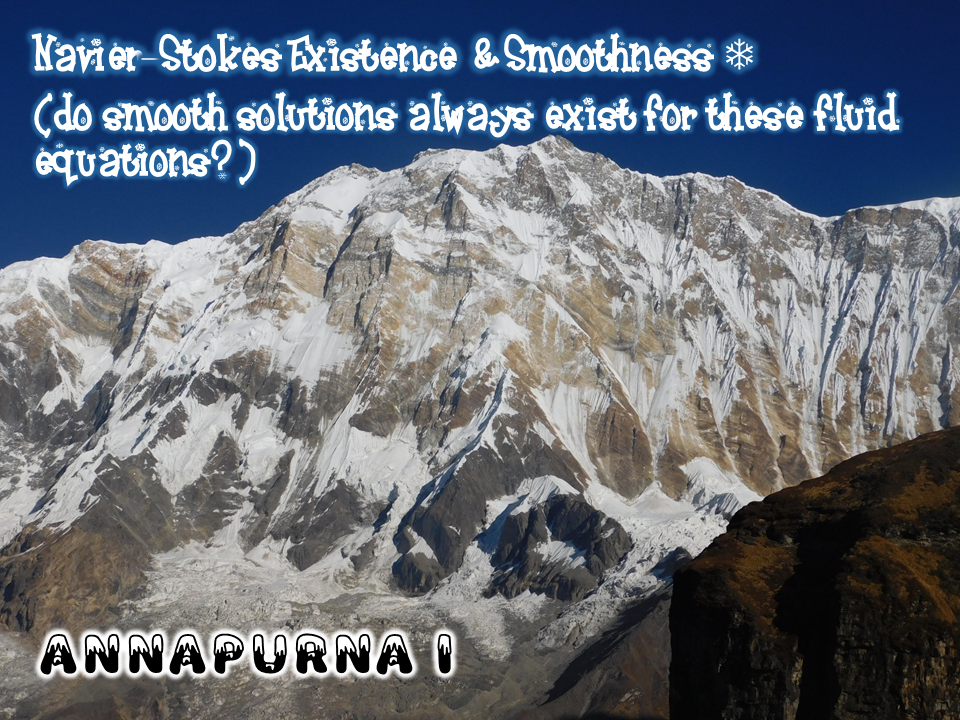
🏔️ Annapurna I: The Navier–Stokes Existence and Smoothness Problem
A $1,000,000 Clay Millennium Prize problem on the equations of fluid motion. Six paths to the summit. Together, we climb.
Our Sherpa guide welcomes us: Hi! I'm Olga Ladyzhenskaya 👋, the legendary Russian mathematician 🇷🇺 who solved the viscous, complex Navier–Stokes equations used in global weather forecasting 🌦️🧮. I was famously fearless and fiercely spirited 🔥 both in and out of the lab. Let me tell you a funny story! 😄 While on a trip to the United States in my later years, ever-curious, I was taken on a wildlife tour 🌿. Ever the intrepid explorer, I managed to get a close look at a live crocodile 🐊 — but my true goal was to see a skunk in the wild 🦨! As the story goes, my request to hunt down a wild skunk turned out to be one of the very few pursuits in my life where my companions managed to talk me out of it 🙅.The first 8,000-meter peak ever summited was Annapurna I 🏔️, but its 1950 triumph holds a shocking anecdote: climber Maurice Herzog lost all his fingers and toes to frostbite 🥶, and the expedition doctor amputated them without anesthesia in a tent to save his life! 😱⛺ The legendary (and heavily contested) 1950 French expedition is full of fascinating twists that make Annapurna I one of the most compelling stories in mountaineering: No Oxygen: Herzog and Louis Lachenal stood on the summit of Annapurna I (8,091m) without supplemental oxygen 🫁 — a remarkable feat for the era. The Book of Lies: Herzog's account in his book Annapurna became an international bestseller 📖. However, his teammate Lachenal later wrote diaries revealing the climb was chaotic, driven by nationalist propaganda, and that Lachenal nearly abandoned the summit push 🏳️. Deadlier Than Everest: Despite being the first 8,000-meter peak conquered, it has historically been known as the deadliest ☠️. Roughly 1 in 3 climbers who reach the summit do not survive the descent. Goddess of Food: Ironically, the mountain is named after the Hindu goddess of the harvest and nourishment 🌾 — a name translating to "the one who is full of food" 🍲.
The Navier–Stokes existence and smoothness problem is one of the seven Clay Millennium Prize
Problems. It asks whether smooth, finite-energy solutions to the three-dimensional incompressible
Navier–Stokes equations always exist for all time — or whether they can develop a singularity
(a finite-time “blow-up”) starting from smooth initial data.
Below are six paths to the summit — each a mathematically distinct, non-overlapping
approach toward proving global existence and smoothness (or finding a blow-up). Within each path, the
base camps are the coherent subtopics we will study in depth, one expedition at a time.