The holy grail of mathematics. A $1,000,000 Millennium Prize problem. Together, we climb.
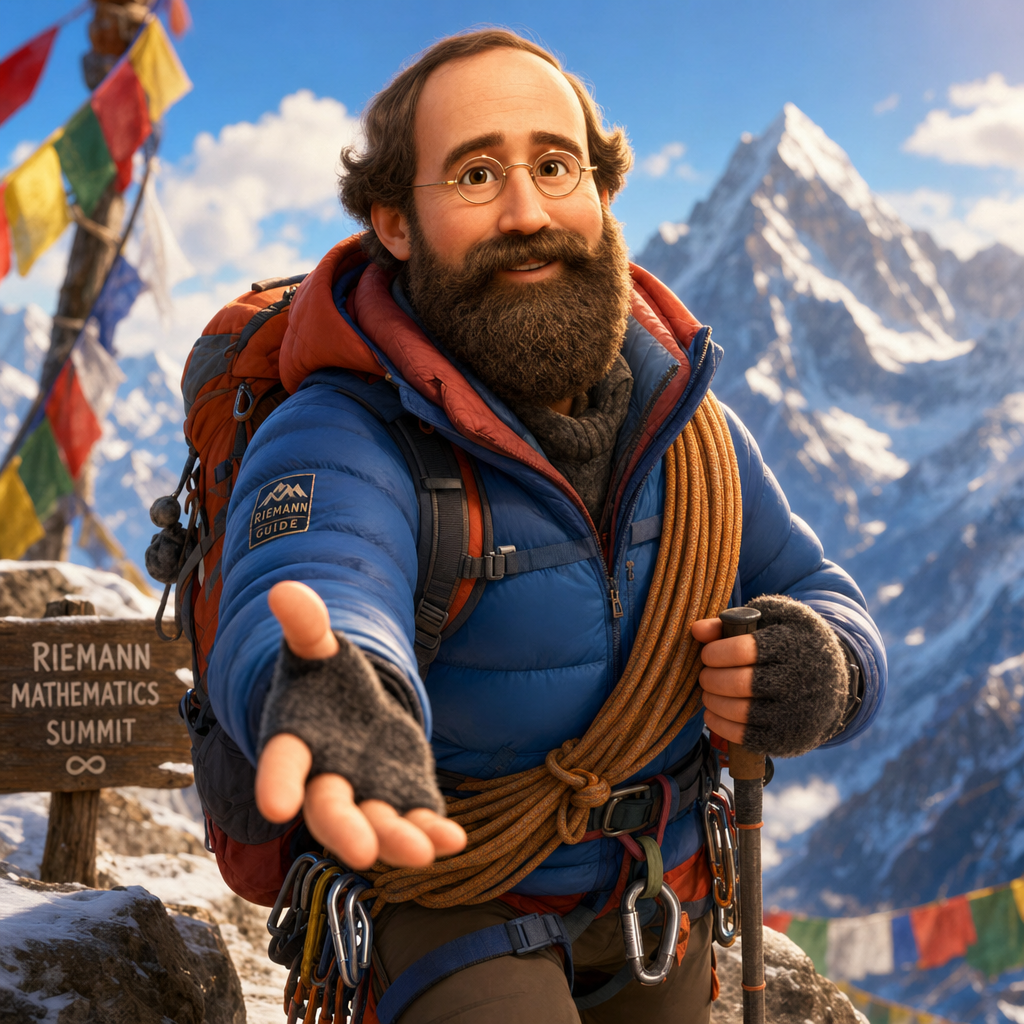
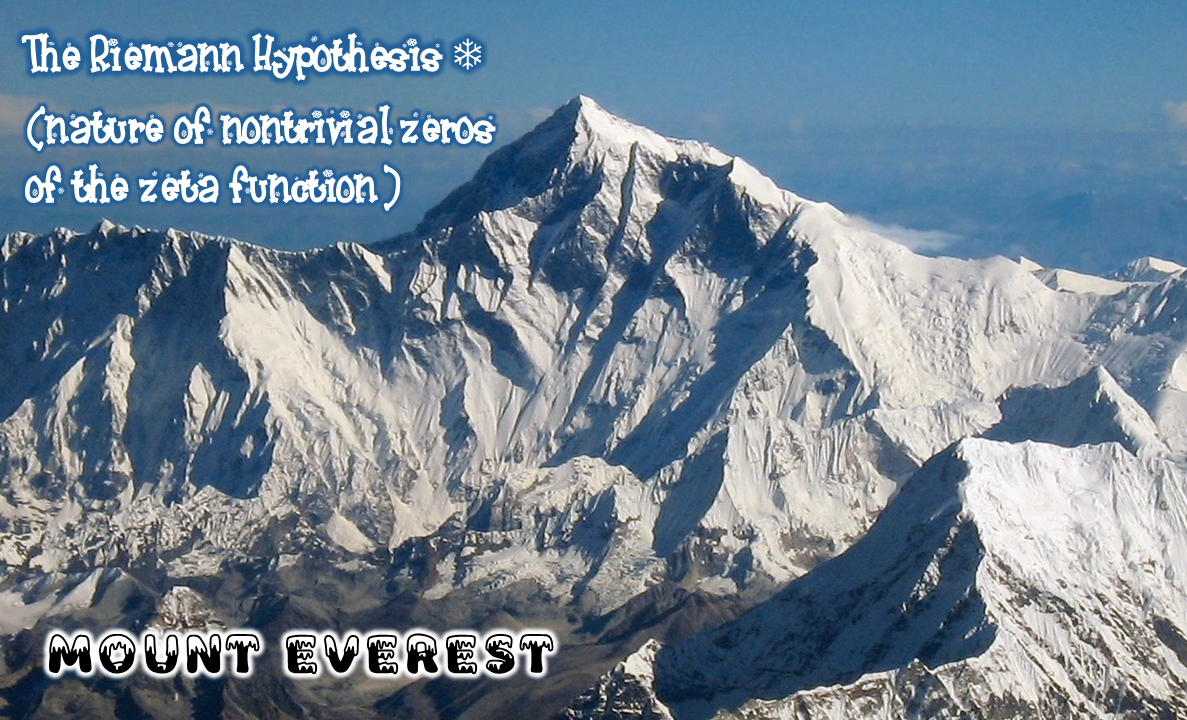
Our Sherpa guide welcomes us: Hi! I'm Bernhard Riemann 👋, a revolutionary German mathematician 🇩🇪 whose profound breakthroughs fundamentally reshaped geometry, number theory, and analysis 📐. Despite a brief career cut short by tuberculosis at age 39 😔, my work provided the mathematical foundation for modern physics, most notably Albert Einstein's general theory of relativity ✨. Let me tell you a funny story! 😄 In 1854, to become a lecturer, I had to propose three topics for a public trial lecture at the University of Göttingen 🎓. I had thoroughly prepared two topics, but my third — on the geometric foundations of space — was completely new. The legendary Carl Friedrich Gauss 🧙♂️, who was overseeing the examination, surprised EVERYONE by passing over my prepared topics and requesting that unprecedented third one. Now, I was known to have a paralyzing fear of public speaking 😰… and suddenly I had to present a totally new, conceptual vision of geometry on the spot. Just five minutes into my lecture, Gauss — a man accustomed to being the smartest person in the room — put down his pen ✍️. He sat entirely motionless for the remaining 40 minutes, mesmerized 😲. I was liberating geometry from three-dimensional limitations, laying the very groundwork of curved spaces that Einstein would later use for General Relativity 🌌. After the lecture, Gauss walked home utterly astonished — my ideas had opened a mind-bending gateway to a reality he had never before considered! 🚪Mount Everest is the highest mountain on Earth, rising 8,848.86 meters (29,031.7 feet) above sea level 🏔️🌍. Located in the Himalayas on the border between Nepal 🇳🇵 and the Tibet Autonomous Region of China 🇨🇳, the peak challenges climbers with extreme weather, the treacherous Khumbu Icefall 🧊, and the "death zone" above Camp 4. The Death Zone: Above 8,000 meters, the oxygen level is too low to sustain human life for long, requiring climbers to use supplemental oxygen and push for the summit and return within a narrow window 😤🫁⏳. For three decades, climbers on Everest's north side passed a body curled in a limestone alcove, marking the spot as "Green Boots" 🥾. Made famous by the book Into Thin Air 📖, it was long believed to be an Indian constable who disappeared in 1996. However, DNA testing 🧬 revealed it was actually his teammate, Lance Naik Dorje Morup. This mix-up left two families with an incorrect account for 30 years 💔. It's just one of many strange and moving tales from the mountain. Here are a few other intriguing pieces of lore: Ancient Marine Life: The summit of the world's tallest mountain is made largely of limestone containing marine fossils 🐚. Roughly 450 million years ago, those rocks were part of the seafloor in an ancient ocean called the Tethys 🌊. The "2 PM Rule": Climbers must hit the summit by 2:00 PM local time 🕑. If they are any later, they are required to turn around to ensure they have enough light, oxygen, and energy to get back to camp safely ⛺. Sea-Level to Summit: In 1990, Australian mountaineer Tim Macartney-Snape became the first person to walk and climb from sea level to the top 🏃. His 1,200 km journey began on the shores of the Bay of Bengal and ended on the summit 🚩.
The Riemann Hypothesis is widely considered the most important unsolved problem in pure mathematics.
It concerns the distribution of prime numbers and predicts that all non-trivial zeros of the Riemann
zeta function lie on the critical line Re(s) = 1/2.
Below are nine paths to the summit — each a different mathematical approach
to understanding and potentially proving the Riemann Hypothesis. Pick the path that calls to you,
and we'll climb together, base camp by base camp.